
Most people think a private family foundation is something you build after you become a billionaire.
That’s wrong. A private family foundation is a charitable entity your family controls. You fund it, you get a deduction, and the foundation carries out charitable work you choose. It is not a trust fund for your kids. It is not a piggy bank. It’s a separate entity with its own rules, its own books, and its own tax return.
Here’s what people get wrong.
They think charity means writing a check to somebody else’s organization and hoping it gets used well. That’s one way to give. A foundation is the other way. The decisions stay inside your family.
How It Works
There are two basic kinds. A non operating foundation mostly collects money and grants it out to other charities. Simple, but limited. An operating foundation runs its own programs. It does the work itself. That’s the one I care about.
The difference shows up in the deduction. Cash you give to an operating foundation can generally be deducted up to 60% of your adjusted gross income. A foundation that just passes money along to other charities gets a lower limit. More work, more room.
Inside an operating foundation, your family can have real jobs. Your spouse can run it. Your kids can work in it. They learn how money and giving work at a level most people never see.
But the job has to be real and the pay has to be fair for the work. You can’t pay your wife $400,000 to run a foundation that gives away twenty grand a year. That’s not a strategy. That’s bullshit, and the IRS knows it when it sees it.
Why It Exists
These rules aren’t loopholes. They were written into the tax code on purpose. When a family takes money it would have paid in tax and puts it to work in the community, the code rewards that.
The wealthy figured this out a long time ago.
Everyone else is still writing checks to the Red Cross in December and calling it a plan.
Who This Is For and How People Screw It Up
This is not for someone who wants a deduction and has no mission. If you don’t actually want to do the charitable work, don’t build a foundation. Write a check and move on.
The money in the foundation is not your money anymore.
You control it, but you can’t spend it on yourself, sell things to it, buy things from it, or use it to prop up your business. Deals between the foundation and your family are called self dealing, and the penalties are brutal. People screw this up all the time because control feels like ownership. It isn’t.
Can a foundation bring in money? Yes. But how it brings it in matters. Income from activities that actually carry out the charitable mission is treated very differently from income from a regular business that has nothing to do with the mission, which can be taxed even inside the foundation. Private foundations also pay a small excise tax on investment income. So anybody telling you everything inside a foundation is automatically tax free is skipping the fine print. Sit down with a CPA who actually works with foundations before you build anything.
And don’t bolt a foundation onto your life just because you heard about it at a conference. If your business, your trusts, and your foundation don’t fit together, you’ve built three problems instead of one structure.
The Bigger Picture
Structure gives you control and options. A foundation is one more entity in the system, sitting next to the business, not tangled up inside it.
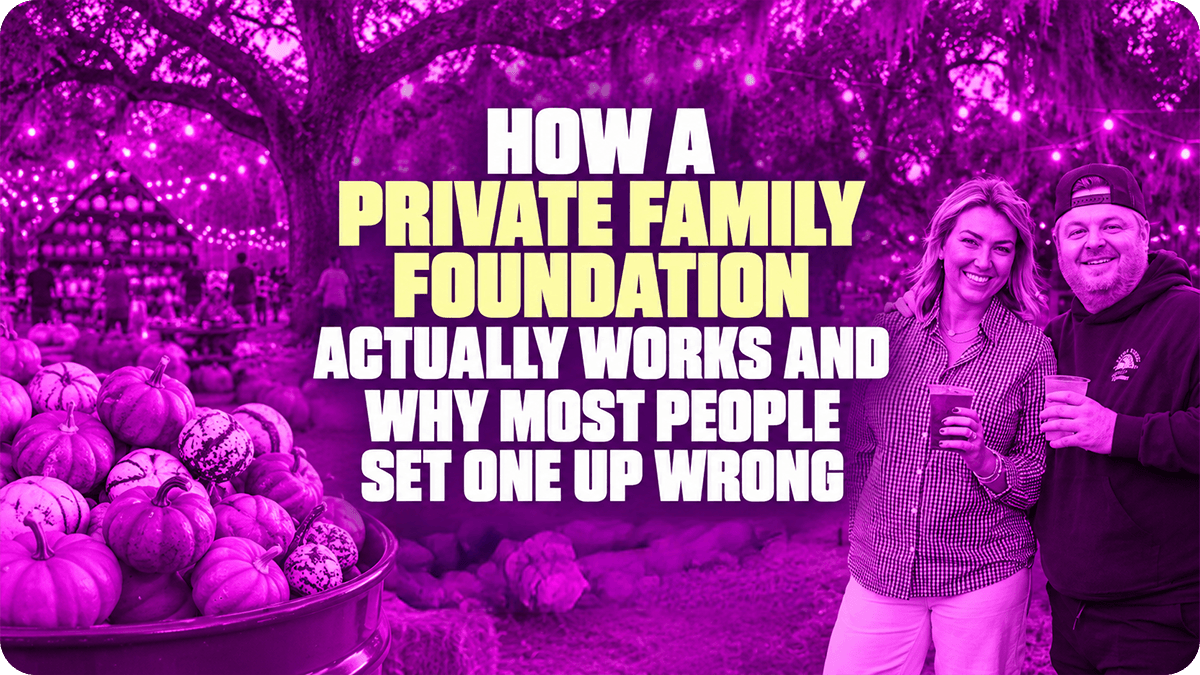
We’re living this right now. This October we opened the oak grove on our 126 acres for our first pumpkin patch, and the community showed up through a weekend of lightning and rain. Next, our family foundation turns its attention to Christmas, with one focus: giving families a true Christmas experience. Big things are coming there.
A foundation is a tool. Build it right and it outlives you. Build it sloppy and it’s just a tax return with a nice name.